


The Other Frontier: How Dutch Business Is Already Deep Inside Indonesia

eyesonindonesia
Amsterdam, August 17, 2026 – If Brazil is the new frontier for Dutch investment, Indonesia is the old one that never really closed. For four centuries the two countries’ histories have been entangled — colonially, then commercially, and now, increasingly, technically. The Netherlands is Indonesia’s second-largest trading partner in Europe and its biggest European investor, with more than $15.5 billion committed since 2013 alone. But what’s happening in 2026 isn’t nostalgia. It’s a live, expanding partnership across exactly the four sectors reshaping Brazil’s own relationship with the Netherlands: port logistics, green energy, ecological farming, and water management. The parallels aren’t accidental — they’re the same Dutch export, applied to two very different deltas.
Water management: where the Dutch aren’t consultants, they’re co-designers
Nowhere is the Indonesia relationship more advanced than on water — and nowhere is it further from a simple export relationship. On the north coast of Central Java, in the district of Demak, Dutch engineers and Indonesian communities have spent the past decade building something that didn’t really exist before: a coastline restored not with concrete, but with mud and mangroves.
The problem was severe. Land subsidence, sea-level rise, and decades of mangrove clearing for aquaculture had left over 70,000 people in Demak’s coastal villages facing tidal flooding that conventional sea walls were too expensive and, ultimately, too ineffective to stop. The response — a program called Building with Nature Indonesia — brought together Wetlands International, the engineering firm Witteveen+Bos, Deltares, Wageningen University, TU Delft, and Indonesia’s own ministries in a genuinely experimental approach: permeable structures of bamboo and brushwood, built to slow waves and trap sediment, giving mangrove forests the physical space to regrow naturally. It’s the same logic as a Dutch salt-marsh restoration, transplanted to a tropical delta 11,000 kilometers away — and it worked well enough that it’s now the template for something far larger.
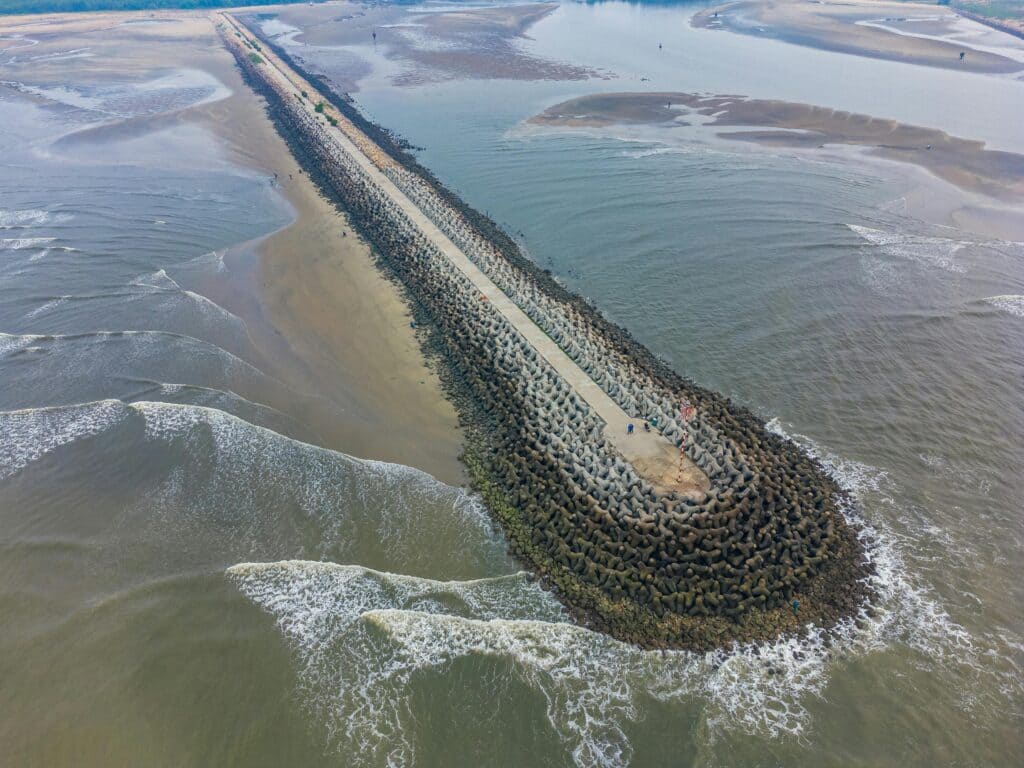
That larger project is Indonesia’s “giant sea wall” — an estimated $80 billion coastal protection initiative for northern Java, where Dutch involvement actually predates the current wave of interest by nearly two decades. The Dutch government has been part of the technical planning since 2008, through the National Capital Integrated Coastal Development programme, and in 2025 the two governments signed 18 memoranda of understanding worth roughly €800 million, including specific commitments to coastal protection work in Cirebon and Demak. Royal HaskoningDHV has since been appointed by Invest International, the Dutch state investment agency, to lead the engineering, environmental, and social feasibility studies for both regions — full end-to-end advisory work on a stretch of coast home to some 50 million people.
It’s the Brazil water story’s mirror image. Where Dutch expertise in Brazil is being pitched around future cold-chain and climate-adaptation projects, in Indonesia it’s already been field-tested at scale, with real villages and a decade of monitoring data behind it.
Port logistics: the dredgers were already there
Rotterdam’s identity as Europe’s logistics gateway is exactly what Dutch firms have spent the past fifteen years exporting into Indonesian waters — not as a future pitch, but as completed infrastructure. Van Oord and Boskalis, the two Dutch dredging and marine engineering giants, have built or expanded a striking share of Indonesia’s modern port capacity: the deepening and expansion of Tanjung Priok in Jakarta — Indonesia’s largest container port — under a contract worth more than €150 million; land reclamation and channel works at Surabaya’s harbour and the Java Integrated Industrial Port Estate; maintenance dredging at the port of Bengkulu in Sumatra; and, in a joint venture worth some €350 million, the reclamation of an artificial island off Jakarta’s coast for the Pluit City development.
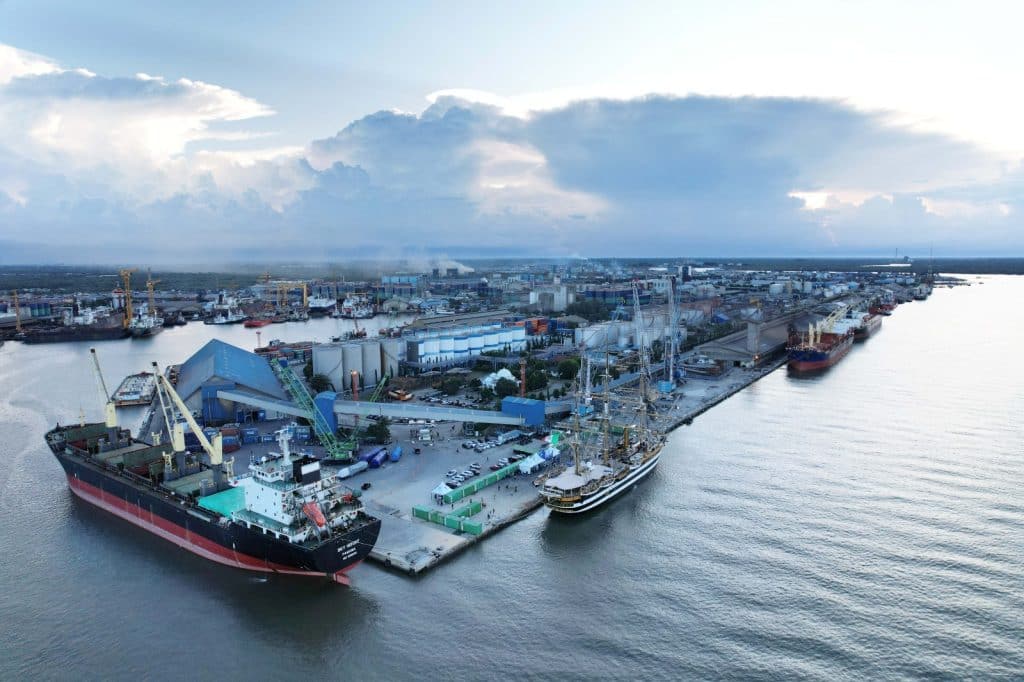
That expertise is now being pointed at newer, larger targets — Kuala Tanjung in North Sumatra, positioned to become Indonesia’s second-largest port after Tanjung Priok, and Patimban on Java’s north coast, both central to a national infrastructure market projected to grow from roughly $101 billion in 2025 to $140 billion by 2031. The same 2025 diplomatic package that funded the Demak and Cirebon water projects also included a formal agreement between Indonesia’s transport ministry and the Dutch infrastructure and water management ministry on mutual recognition of seafarers’ certification — a small but telling sign of how deeply the two countries’ maritime systems are already interlocking.
Green energy: a hydrogen corridor with Indonesia’s name half-written on it
The Port of Rotterdam has spent the past several years turning itself into a hydrogen hub — 32 kilometers of new pipeline linking Maasvlakte to Pernis, a 200-megawatt electrolyser producing 60,000 kilograms of renewable hydrogen a day, and a strategy of building green fuel corridors with international partners willing to supply the feedstock. Rotterdam has already struck exactly this kind of partnership with Brazil, collaborating with the port of Pecém in Ceará to build a green hydrogen supply chain, and with India on a green and digital maritime corridor aimed at port digitalization and green shipping.
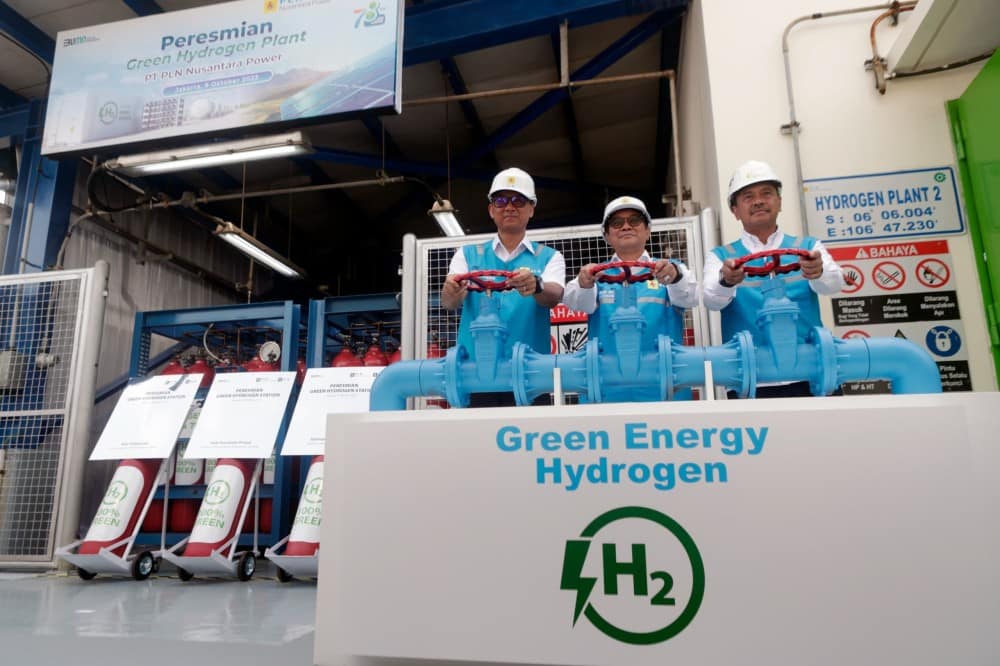
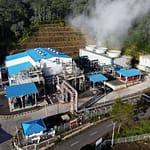
Indonesia — sitting on some of the world’s best solar and geothermal potential, and already a significant player in nickel and battery-metal supply chains — is a natural candidate for the same model, and the early architecture is being laid. Waste-to-energy projects at the Legok Nangka landfill in West Java were among the priority initiatives named in the 2025 Dutch funding commitments, and Invest International’s broader €300 million financing envelope for Indonesia explicitly includes renewable energy and waste management alongside water and agriculture. It’s an earlier-stage relationship than the water and ports story — but it’s built on the same instinct: a country with abundant renewable potential and a port system that badly needs the kind of energy-transition infrastructure Rotterdam has already proven works.
Ecological farming: exporting the Westland model, one greenhouse at a time
The Netherlands is, almost unbelievably for a country its size, the world’s second-largest agricultural exporter — a fact built almost entirely on 100 square kilometers of glass in and around Westland, where roughly 80% of cultivated land sits under greenhouse cover and a single tomato seed can be bred to produce over 150 pounds of fruit. That expertise is now explicitly being transplanted into Indonesian soil, not as a sales pitch but, in the words of the Dutch agriculture ministry’s own deputy director-general, as a genuine partnership: “we bring innovation, but we also want to understand the local situation.”
In June 2025, Indonesia’s deputy minister of agriculture and his Dutch counterpart formalized a greenhouse-based horticulture partnership aimed squarely at food security, with plans to build over 150 greenhouses in Indonesia through 2025-2026 alone, alongside a scholarship program designed to train the next generation of Indonesian growers in Dutch cultivation techniques. Dutch companies including Brinkman, Hoogendoorn, and Metazet have been demonstrating live ASEAN projects at regional trade events through 2026, working on climate-resilient growing techniques suited to hot, humid conditions rather than simply exporting a Dutch design wholesale. The Netherlands is also backing Indonesia’s “Farm of the Future” food estate initiative in North Sumatra, and has named sustainable palm oil production and agroforestry as strategic priorities in its own bilateral development framework — an acknowledgment that ecological farming in Indonesia has to mean something broader than greenhouse glass alone.
Same playbook, older friendship
The pattern across all four sectors is consistent, and it’s the same one now emerging in Brazil: Dutch firms don’t show up to sell finished products. They show up with a century of accumulated expertise in fighting water, growing more food on less land, and moving cargo efficiently — and they adapt it, slowly and specifically, to wherever it’s needed next. What sets Indonesia apart is simply time. The Demak mangroves have had a decade to regrow. The Tanjung Priok dredgers finished their work years ago. The greenhouse partnership already has its first scholarship cohort. Where Brazil represents the opening chapter of this story, Indonesia is several chapters in — and increasingly, it’s the place where the Netherlands is testing the very techniques it hopes to bring everywhere else.