


Two Green Giants, Two Very Different Doors

How Indonesia’s Climate Finance Strategy Stacks Up Against Brazil’s Eco Invest
Brazil built one clear, repeatable front door for green capital. Indonesia built an entire wing of doors — bigger in scale, richer in ambition, but a genuinely different experience for the investor trying to find the right one to knock on.
eyesonindonesia
Amsterdam, July 31, 2026 – If Brazil’s Eco Invest program is a single, well-lit entrance with a published rulebook and a queue number, Indonesia’s approach to attracting green capital looks more like a sprawling government complex: several ministries, a sovereign wealth fund, an international donor coalition, and a central bank all running their own wings of the same building. Both countries are racing toward the same goal — mobilizing foreign private capital for the energy transition — but they’re getting there through structurally different playbooks, and the difference matters enormously for anyone deciding where to send their next check.
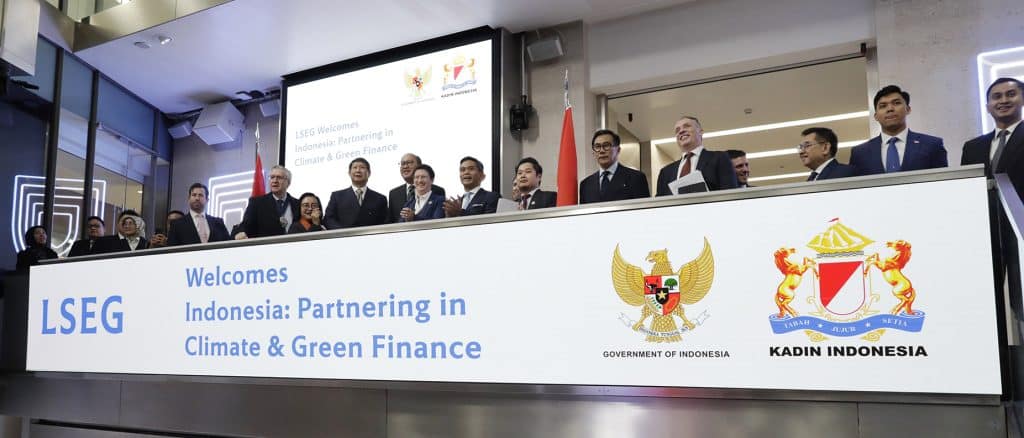
Indonesia’s Multi-Front Strategy
Indonesia isn’t short on ambition or on capital in motion. In February 2026, Coordinating Minister for Economic Affairs Airlangga Hartarto announced that Indonesia had already disbursed roughly $3.5 billion from two major international financing mechanisms — the Just Energy Transition Partnership (JETP) and the Asia Zero Emission Community (AZEC) — to fund green economy projects. That sits alongside a much larger domestic commitment: the 2026 State Budget allocates 404.2 trillion rupiah, roughly $24 billion, to national energy security, including green economy initiatives.
The country is channeling that capital through a genuinely diverse set of vehicles:
- JETP-backed flagship projects, including the Sulawesi Green Energy Corridor and a dedicated Green Bond Development Facility, targeting a renewable energy potential the government estimates at up to 3,686 gigawatts, alongside plans for a 70-kilometer green super grid.
- Danantara, Indonesia’s state investment management agency, which is accelerating a pipeline of waste-to-energy plants expected to come online from March 2026 — a sovereign-wealth-style vehicle Brazil’s program doesn’t have a direct equivalent to.
- Green Sukuk, Islamic-compliant green bonds that have made Indonesia a genuine innovator in Shariah-based climate finance, expanding the pool of capital sources beyond conventional Western institutional investors.
- Bank Indonesia’s regulatory overhaul, announced at the Global Sustainable Development Congress in June 2026, which will require banks to embed carbon accounting directly into lending decisions — a central-bank-led push that Heru Rahadyan, the bank’s Head of Green Economy Empowerment, framed as reshaping “how capital flows,” not just signaling intent. The central bank has also warned that unmanaged climate risk could hit 40% of GDP, giving the push real urgency.
- BKPM’s Green Growth Program, a multistakeholder platform run by Indonesia’s investment board that develops bankable projects tied to the country’s climate commitments and connects them with matching sources of finance.
- International blended finance deals, including a $2.128 billion World Bank package approved in 2025 that piloted a novel “step-up loan” structure — favorable rates during implementation, with built-in incentives for private capital to join over time.
Layer on the G20 Bali Global Blended Finance Alliance, which Indonesia launched during its 2022 G20 presidency to help close the global SDG financing gap, and a newly forming Sustainable Finance Committee meant to coordinate all of this — and the picture that emerges is a country genuinely mobilizing enormous sums, across an unusually wide range of instruments, sectors, and institutions.
Brazil’s Single Door
Set that against Eco Invest Brasil, and the contrast is immediate. Brazil’s Ministry of Finance and National Treasury run one recurring, centralized mechanism: a sequence of numbered auctions (the current round is number five), each governed by a published Operational Manual, each with explicit, non-negotiable leverage requirements — private institutions must bring at least twice the public capital to the table — and each targeting a defined, publicly announced list of strategic sectors for that specific round. There’s no ambiguity about where to apply, what the rules are, or how proposals get ranked; the government has effectively built a recurring, competitive application process that investors can learn once and use again in each subsequent round.
What Each Approach Gets Right
Indonesia’s strength is scale and diversity of capital sources. Between JETP and AZEC disbursements, the state budget allocation, Danantara’s sovereign firepower, and green sukuk issuance, Indonesia is pulling capital from international donor coalitions, Islamic finance markets, its own sovereign balance sheet, and conventional development finance all at once. That diversification is a genuine hedge — if one channel slows, several others keep moving. It also reflects Indonesia’s structural position as an archipelago nation with genuinely enormous untapped renewable potential, which gives it a scale story Brazil’s program, focused on six specific supply chains, doesn’t attempt to tell in the same way.
Brazil’s strength is clarity and repeatability. An investor evaluating Eco Invest’s 5th Auction can read one manual, understand exactly how proposals will be scored, know precisely how much leverage is required, and expect the 6th Auction to follow a recognizably similar structure. That predictability is worth a great deal to institutional capital that prizes process certainty as much as the underlying opportunity — it’s notable that the Brazilian Treasury has described the 4th Auction as achieving strong capital mobilization, evidence the model is working and improving round over round.
The Honest Trade-Off
Neither approach is simply “better.” Indonesia’s model can mobilize genuinely larger absolute sums and taps financing pools — Islamic finance, sovereign wealth vehicles, multilateral donor coalitions — that Brazil’s program doesn’t directly draw on. But that same breadth asks more of an investor: understanding whether a project fits best under JETP, AZEC, Danantara, a green sukuk issuance, or a BKPM-brokered deal is a genuinely more complex navigation exercise, and Indonesia’s own Sustainable Finance Committee is, as of this year, still being built specifically to bring more coordination to that landscape — an implicit admission that fragmentation has been a real cost.
Brazil’s model, by contrast, sacrifices some of that scale and diversity for a single, legible front door — a trade-off that favors investors who value simplicity and repeatable process over Indonesia’s broader menu of instruments and capital sources.
The Bigger Picture
Both countries are ultimately running the same experiment: using public capital deliberately to de-risk and multiply private investment in the energy transition, rather than simply hoping the market gets there alone. Indonesia is testing that idea across many parallel channels at once; Brazil is testing it through disciplined repetition of a single, refined mechanism. For a foreign investor weighing where to place green capital in 2026, the real question isn’t which country is more serious about the transition — both clearly are. It’s whether you’d rather learn one door very well, or have the patience to find the right one among several.